
The superyacht market — long the domain of wire transfers, offshore trusts, and complex financing arrangements — has emerged as one of the most enthusiastic adopters of cryptocurrency in the luxury sector. In 2024, over $100 million in superyacht transactions were completed in digital assets, a figure that continues to grow as crypto-wealthy buyers seek to deploy capital without the friction of traditional finance.
Superyacht Dealers and Brokers Accepting Cryptocurrency
Denison Yacht Sales
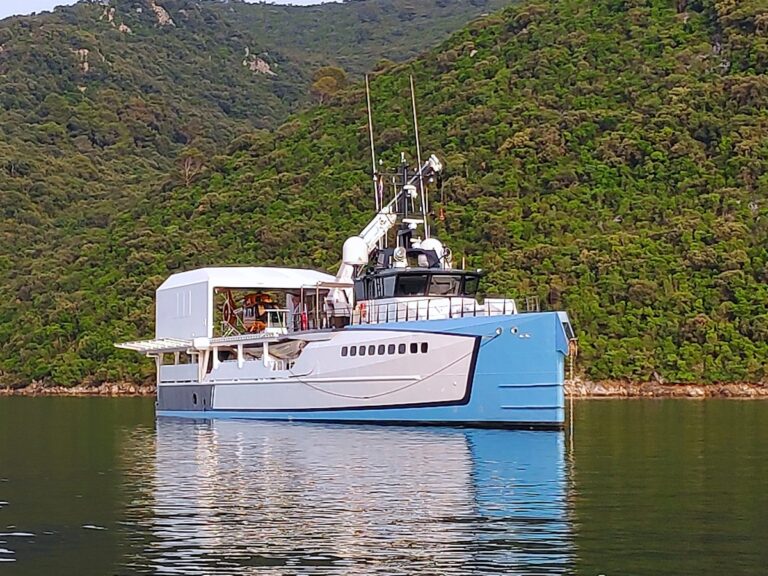
Denison Yacht Sales completed one of the most significant crypto yacht transactions in history in early 2025: the acquisition of Project OBSIDIAN BLADE, a 41-meter Aegean superyacht, purchased entirely in Bitcoin. Working in partnership with Bitcashier — a payment processor specializing in high-value crypto transactions — Denison offers price-locked exchange rates and escrow coordination for buyers transacting in BTC, ETH, and USD stablecoins. The firm handles superyacht sales, charter brokerage, and management services. Visit: denisonyachtsales.com
Greenline Yachts
German manufacturer Greenline Yachts has accepted Bitcoin since 2018 — making it one of the longest-standing crypto-friendly yacht brands in the world. At boot Düsseldorf 2025, the company completed a celebrated transaction: a Greenline 45 Coupe sold to a buyer who had acquired his Bitcoin at $0.03 per coin. All transactions are processed in euros through the company’s BitPay partnership, eliminating currency risk for both parties. Visit: greenlinehybrid.com
SuperYachtsMonaco
Operating from the world’s most prestigious yachting address, SuperYachtsMonaco renewed its cryptocurrency partnership with Bitcashier in 2024, enabling purchases, charters, and ongoing management payments in Bitcoin, Ethereum, and other major digital assets. The Monaco firm specializes in the ultra-high-end segment — vessels of 30 meters and above — and caters to a clientele for whom crypto is not merely a payment method, but a lifestyle. Visit: superyachtsmonaco.com
Gulf Craft
Bahrain-based Gulf Craft, one of the largest yacht manufacturers in the Middle East, has partnered with fintech platform ARP Pay to accept USDT and USDC stablecoins for yacht acquisitions and refits. The stablecoin focus reflects growing demand from Gulf clients who prefer the price stability of dollar-pegged assets for significant capital commitments.
How Crypto Yacht Transactions Work
For yacht purchases — which routinely run from $500,000 to well above $50 million — specialized escrow arrangements provide protection for both buyer and seller. Payment processors such as Bitcashier lock the exchange rate at invoice generation, converting crypto to fiat upon receipt. This protects against market volatility while preserving the buyer’s ability to transact in digital assets.
Charter transactions follow a simpler process: a payment link is generated with a fixed-rate window (typically 90 minutes), the buyer sends cryptocurrency to the provided wallet address, and confirmation arrives within minutes. For season-long charters or yacht management agreements, stablecoin payments are increasingly preferred for their predictability.
The Market Outlook
The convergence of superyacht culture and cryptocurrency wealth is not accidental. The demographic profiles overlap almost entirely: individuals who made significant wealth through technology, early crypto adoption, or high-performance investing, and who view the superyacht not merely as a vessel but as a statement of financial sovereignty. As crypto wealth continues to mature — and as regulatory frameworks around digital assets become more defined — the superyacht market is positioned to see continued growth in crypto-funded acquisitions.
The Verified Brokers: Who Accepts Bitcoin for Superyacht Charter
Burgess Yachts
Accepted crypto: Bitcoin (BTC), Ethereum (ETH) via specialist arrangement
Minimum charter value: €100,000/week (crypto facilitation available for all charter tiers above this)
Fleet access: 400+ yachts globally, 25m–180m
Website: burgessyachts.com
Last Verified: April 2026
Burgess Yachts is one of the three largest superyacht brokerage firms globally, with offices in Monaco, London, New York, and Fort Lauderdale. Their crypto settlement capability is available through their senior broker team and is typically arranged for established clients with prior KYC verification. For charter of vessels above 50m — where weekly rates exceed €250,000 — crypto settlement is particularly welcomed as an alternative to international wire transfer complexity.
Fraser Yachts
Accepted crypto: Bitcoin (BTC), stablecoins (USDC preferred for large transactions)
Minimum for crypto: €75,000 total transaction value
Speciality: Mediterranean, Caribbean, Southeast Asia, Pacific routing
Website: fraseryachts.com
Last Verified: April 2026
Fraser Yachts has been particularly progressive in adopting USDC for charter settlement — their preference for stablecoins reflects the operational reality that yacht owners who receive charter income want price certainty. For charterers, USDC settlement also eliminates the BTC rate-lock complexity and allows payment on the day of departure without time-pressure. Their Mediterranean and Caribbean routing coverage is particularly strong for peak summer and winter seasons.
Charter Yacht Categories and Bitcoin Pricing
Motor Yachts (25–40m): The Entry Point
Weekly base rate: €25,000–€80,000
BTC equivalent (indicative): 0.08–0.27 BTC/week
Typical capacity: 6–8 guests, 4–6 crew
Representative vessels: Azimut Grande 35M, Sunseeker 86 Yacht, Princess 30M
The 25–40m range represents the most accessible tier for high-net-worth crypto holders chartering for the first time. These yachts offer full crew service, air-conditioned cabins, and Mediterranean or Caribbean cruising capability without the operational complexity of larger vessels. The Princess 30M, with its planing hull, can cover 300nm in a day — enabling significant itinerary flexibility in Greek or Croatian waters.
Superyachts (40–60m): The Sweet Spot
Weekly base rate: €80,000–€250,000
BTC equivalent (indicative): 0.27–0.83 BTC/week
Typical capacity: 10–12 guests, 10–15 crew
Representative vessels: Benetti 50m, Heesen 47m, Feadship 55m
The 40–60m category offers the first genuine “full service” superyacht experience — a dedicated chef with menu design consultation, beach club with watersports platform, stabilisation for comfortable anchorage, and enough crew for seamless, invisible service. A Heesen 47m or Feadship in this range typically has 5–6 guest cabins including a full-beam master suite, gym, beach club, and water toys including Seabobs, jet skis, and tenders.
Megayachts (60m+): The Flagship Experience
Weekly base rate: €250,000–€3,000,000+
BTC equivalent (indicative): 0.83 BTC–10+ BTC/week
Typical capacity: 12–18 guests, 20–50+ crew
Representative vessels: Lürssen 80m, Feadship 90m, Oceanco 110m+
At the megayacht level, the vessel itself becomes the destination. Fully custom interiors by Remi Tessier, Winch Design, or Nuvolari Lenard; helipads for guest transfer and owner privacy; submarine garages; on-board cinema and IMAX-quality screening rooms; dedicated DJ booths and nightclub spaces; full-service spas. The Advance Provisioning Allowance (APA) at this level — covering fuel, food, beverages, port fees, and water toys — represents a further 30–40% on top of the base charter rate, often 1–3 BTC/week in additional cost.
The Charter Agreement: What to Expect
All professional superyacht charters use MYBA (Mediterranean Yacht Brokers Association) standard charter agreements. Key provisions to understand:
The APA (Advance Provisioning Allowance): Typically 30–40% of the base charter rate, paid in advance and held in escrow. The captain draws from the APA for running expenses during the charter (fuel, food, port fees, water toys, communications). At the end of the charter, you receive an itemised reconciliation — surplus is refunded, deficit is billed. The APA for a €100,000/week charter is typically €30,000–€40,000.
Delivery and Re-delivery ports: The charter agreement specifies where the yacht is delivered to you (and returned). Delivery ports outside the vessel’s home base incur a repositioning fee. For crypto holders chartering in the Eastern Mediterranean (Greece, Turkey, Croatia), delivery from Monaco or Palma de Mallorca is common and typically adds €5,000–€20,000 per leg.
VAT and taxes: EU charter VAT applies at the flag state rate (6% Malta, 12% Greece on Mediterranean portion, 20% France for French waters). Non-EU charters (Caribbean BVI, Bahamas, Maldives, Pacific) are typically VAT-free. Structure your itinerary with your broker to optimise the tax position — sailing outside EU territorial waters for a portion of the charter materially reduces the VAT applicable.
Charter rate data sourced from MYBA, Burgess Yachts market reports, and Fraser Yachts Mediterranean Rate Guide 2026. Last Verified: May 2026.
Buying a Superyacht with Bitcoin: The Acquisition Process
Purchasing a superyacht is the most complex luxury transaction most UHNW individuals undertake. The process involves multiple jurisdictions, specialist legal and technical advisers, sea trials, regulatory compliance, and crew employment — all before the vessel is physically delivered. When Bitcoin is added to the payment structure, an additional layer of currency conversion and compliance management is required.
Phase 1: Survey and Specification (Weeks 1–8)
New-build purchases begin with specification: hull size, builder nationality (Lürssen, Feadship, and Oceanco for flagship; Heesen, Amels, and Benetti for the 40–70m category), interior design brief, and technical specification. Engage a yacht designer (Winch Design, Remi Tessier, Sinot) and a technical superintendent simultaneously. Pre-owned purchases begin with a survey by an independent marine surveyor and a full technical inspection at a reputable yard.
Budget 1–2% of vessel value for advisory fees in this phase: naval architect review, technical superintendent, and lawyer initial retainer. For a €20M vessel, this is €200,000–€400,000 — a necessary investment to avoid purchasing a problematic asset at any price.
Phase 2: Negotiation and Heads of Agreement (Weeks 8–16)
Once the vessel and price are agreed in principle, a Memorandum of Agreement (MOA) — the yacht equivalent of a heads of agreement — is signed, typically using the Norwegian Sale Form (for pre-owned vessels) or a bespoke new-build contract. The payment schedule is established: typically 10% on contract signing, 10% at steel cutting (new-build), 10% at launch, and 70% at delivery — or 10% deposit, 90% at delivery for pre-owned.
For Bitcoin payment: the BTC equivalent of each instalment is calculated at the rate prevailing on the contractual payment date, with conversion managed by a regulated OTC desk. The seller receives EUR/USD; you have disposed of BTC at market rate and generated a capital gains event in your home jurisdiction. Your crypto tax adviser should be engaged from this phase.
Phase 3: Flag State Registration and Crew
Superyachts are registered under a flag state — Cayman Islands, Marshall Islands, British Virgin Islands, and Malta are the most common for private vessels. Flag state determines the applicable maritime law, crew certification requirements, and — critically — VAT treatment when operating in EU waters. A Cayman-flagged vessel owned through a Cayman company can operate commercially in Mediterranean EU waters with specific VAT structuring, potentially reducing or eliminating EU VAT liability.
Crew costs are significant: a 45m motor yacht requires a captain (€120,000–€180,000 per year), chief officer, chief engineer, chef (€80,000–€120,000), two deckhands, stewardess/interior team — a full crew of 7–10 with a total annual wages bill of €500,000–€800,000. Professional crew management companies (Viking Crew, Quay Crew) can manage this entirely, including payroll, social security in crew home jurisdictions, and STCW certification compliance.
The Charter Income Strategy: Offsetting Costs with Your Yacht
A well-managed charter programme can offset 30–60% of a superyacht’s annual operating costs. For a 45m motor yacht with annual running costs of approximately €1.5M, generating €600,000–€900,000 in charter income through a managed programme significantly changes the ownership economics.
Charter management agreements with major brokers (Burgess, Fraser, Camper & Nicholsons) typically involve the broker managing marketing, bookings, crew briefings, and APA reconciliation in exchange for 15–20% of charter income. The owner receives the balance. Some brokers structure agreements where the owner commits minimum availability periods (8–14 weeks per year) in exchange for guaranteed minimum income — providing revenue certainty for financial planning purposes.
A charter-earning vessel operating under a commercial flag state (Cayman, Marshall Islands) with a commercial MCA/USCG approved crew is also eligible for capital allowances and operating expense deductions in certain jurisdictions — your maritime accountant will structure this appropriately. The combination of charter income, tax efficiency, and personal use value makes superyacht ownership more economically compelling than the headline price suggests.
Top Destinations: Where Superyacht Owners Deploy Their Vessels
Mediterranean (June–September): The Western Med (Balearics, French Riviera, Sardinia, Corsica) and Eastern Med (Greek Islands, Turkish Turquoise Coast, Montenegro) remain the world’s premier superyacht cruising grounds. The Greek Islands alone offer over 200 inhabited islands across the Cyclades, Dodecanese, and Ionian chains, with new anchorages accessible only by yacht.
Caribbean (November–April): The British Virgin Islands, St. Barths, Antigua, and the Grenadines define Caribbean superyacht cruising. The Leeward Islands passage from St. Martin to Grenada covers some of the most consistently protected sailing waters in the world, with reliable trade winds and minimal swell for comfortable long-distance passage.
Southeast Asia (October–May): Thailand’s Phuket and the Andaman Sea, the Komodo National Park in Indonesia, and Raja Ampat in West Papua represent the frontier of superyacht exploration cruising — extraordinary biodiversity, minimal traffic, and genuinely untouched anchorages. The practical consideration: crew must be PADI certified for dive operation, and a medical evacuation plan is essential for remote Indonesian waters.
Charter rate data and vessel pricing sourced from Burgess Yachts, Fraser Yachts, and the MYBA 2026 market report. Running cost estimates based on Camper & Nicholsons operational data. Last Verified: May 2026.
Crew Management: The Hidden Cost Centre
For owned yachts, crew represents the single largest ongoing operational cost, typically exceeding fuel, docking, and maintenance individually. The Professional Yachtmaster and Officer of the Watch qualification framework (RYA/MCA) sets the training and certification standard for commercial flag-state vessels, and owner’s yachts operating under a charter licence must comply with the Maritime Labour Convention (MLC 2006) for crew employment contracts, wages, and working conditions.
On a 30-metre yacht, a crew of five — captain, chief officer, chef, stewardess, and engineer — costs approximately €500,000–€700,000 per year in combined salaries, STCW training, MLC-compliant employment contracts, and crew agency placement fees. A 50-metre yacht with a crew of eight to ten will run €1.2–€1.8 million annually in crew costs alone before accommodation, uniform, provisioning, and repatriation allowances. The captain’s salary alone on a 50-metre vessel ranges from €8,000–€15,000 per month depending on vessel type, experience, and flag state.
Crew management companies — including Crew Matters, YPI Crew, and Palma Crew — handle the full recruitment, compliance, and payroll cycle on behalf of yacht owners. For owners new to the industry, delegating crew management to a specialist agency is strongly recommended to ensure MLC compliance and minimise legal exposure from employment disputes, which are governed by the flag state’s maritime law.
Technology and Smart Yacht Systems
New-build superyachts are increasingly defined by their technology specification as much as their naval architecture. Integrated AV systems, satellite connectivity, and vessel management platforms have become standard at the 30-metre-and-above tier. Starlink Maritime, launched commercially in 2022, delivers 100–350 Mbps download speeds with low latency suitable for video conferencing and high-quality streaming — a significant upgrade over VSAT systems that previously dominated the yacht market at substantially higher cost.
Vessel management systems such as Dockmaster, Helm Operations, and YachtSmart integrate navigation data, maintenance scheduling, crew documentation, and charter accounting into a single platform. For owners running a commercial charter operation, these platforms are essential for ISM Code compliance documentation and for generating the operational records required by flag state authorities at annual survey. Smart home-style interior controls — from Crestron and Lutron systems for lighting and climate to integrated security and guest entertainment — are now standard on new builds above €10 million and available as retrofits on existing vessels.
Environmental Regulations and the IMO Framework
The International Maritime Organization’s 2020 sulphur cap (IMO 2020) requires all vessels to use fuel with a maximum 0.5% sulphur content, down from the previous 3.5% standard. For yachts operating in Emission Control Areas (ECAs) — including the Mediterranean, North Sea, and US coastal waters — the cap is 0.1%. Compliance requires either switching to low-sulphur marine gas oil (MGO), installing an exhaust gas cleaning system (scrubber), or transitioning to alternative fuels such as LNG or methanol.
Hybrid and full-electric propulsion is increasingly available for day boats and explorer-category yachts up to 40 metres. Sanlorenzo’s SL90 Asymmetric hybrid, Sunseeker’s hydrogen fuel cell programme, and Ferretti Group’s Riva and Pershing electric prototypes indicate the direction of the market. For new-build buyers at the 30-metre tier, specifying hybrid propulsion adds 15–25% to build cost but reduces operational fuel expense significantly, particularly for owners who use their vessel for extended passage-making. For charter operators in environmentally sensitive areas such as the Croatian archipelago, Greek islands, and French Polynesia, environmental credentials are increasingly a client selection criterion.
Superyacht Market Outlook for Crypto Buyers
Global superyacht order books reached record levels in 2021–2022, driven partly by crypto wealth and partly by pandemic-era demand for private travel. The 2023–2024 delivery pipeline has been substantial, and the market has moderated from peak frenzy — an environment that actually benefits buyers, as negotiating leverage has returned on new-build contracts and pre-owned inventory has expanded. The Global Order Book tracked by Superyacht Intelligence shows over 1,000 vessels in build above 24 metres globally, with the 30–50 metre segment representing the highest volume and the greatest activity among first-time superyacht buyers.
For cryptocurrency holders, the superyacht market offers a compelling intersection of luxury use, asset holding, and income potential through charter. Direct crypto payment acceptance — particularly BTC and USDT — is now established through major brokers including Burgess and Fraser, and the Middle Eastern and Southeast Asian markets are particularly receptive to crypto-denominated transactions. As digital asset wealth continues to mature and diversify into tangible holdings, the superyacht sector is positioned to capture a growing share of that capital.
Last Verified: May 2026. All pricing reflects current market rates from Burgess Yachts, Fraser Yachts, and published industry data from Superyacht Intelligence and MYBA.
Choosing Between Ownership and Charter Access: The Honest Analysis
For many crypto-wealthy individuals approaching the superyacht market for the first time, the honest analysis leads to charter rather than ownership — at least initially. Full ownership of a 30-metre yacht commits the buyer to $500,000–$900,000 annually in operating costs before a single day on the water, and requires active management attention across crew, maintenance, flag state compliance, and charter income if applicable. Charter access via a preference account with Burgess or Fraser, or via a yacht membership programme such as The Yacht Week or SH Collection, delivers comparable lifestyle experience at a fraction of the total cost commitment.
The crossover point — where ownership begins to offer superior value — depends on usage intensity. Buyers who will genuinely use their vessel 60+ days per year, who want total privacy and full customisation of the onboard experience, and who view the yacht as a diversified store of value within a broader asset portfolio, will find ownership compelling. Buyers who aspire to a superyacht lifestyle but realistically anticipate 20–30 days of use per year will likely find that premium charter is more economical and less administratively burdensome over a 5-year horizon.
The market for fractional superyacht ownership — through structures such as SeaNet Europe or Marinetek’s co-ownership programmes — offers a middle path: structured ownership of a defined usage share (typically 4–8 weeks annually) in a professionally managed vessel, with costs apportioned among co-owners. Cryptocurrency payment for fractional shares is accepted by select operators, making this an accessible entry point for crypto buyers who want genuine ownership stake without the full operational burden.
Last Verified: May 2026. All charter rates, broker data, and ownership cost estimates reflect current market conditions sourced from Burgess Yachts, Fraser Yachts, MYBA, and Superyacht Intelligence.
Further Reading
The Vetted Index
Browse all 96 verified luxury brands accepting cryptocurrency, filterable by category and coin. Explore The Vetted Index →