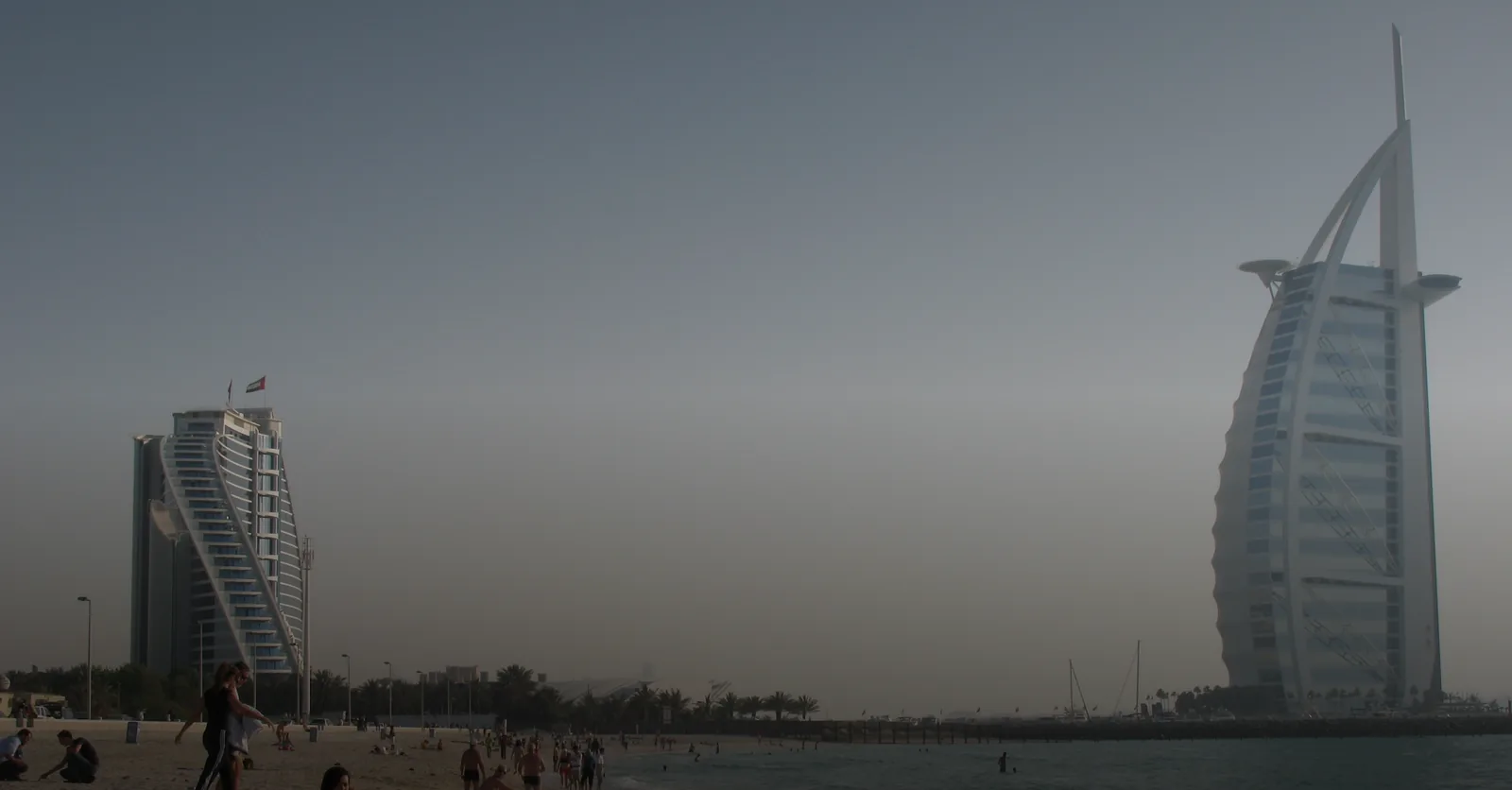

The Burj Al Arab stands in a category entirely its own. Opened in 1999 on its own artificial island 280 metres off the Jumeirah coastline, the sail-shaped tower remains the most recognised hotel silhouette in the world — and at the Jumeirah Group, the question of how ultra-high-net-worth guests settle their accounts has evolved considerably. For Bitcoin holders and crypto-affluent travellers, Dubai has emerged as the world’s most hospitable luxury market, and the Burj Al Arab is its crown jewel.
The Property: What Makes the Burj Al Arab the Standard
The Burj Al Arab is technically defined as a tower hotel with 202 duplex suites — there are no standard rooms. The entry category, the Deluxe Suite, begins at approximately 170 square metres. The Royal Suite, occupying three floors at the summit of the tower, stretches across 780 square metres and includes a private cinema, a billiards table, a rotating four-poster bed, and butler service that never sleeps. Presidential accommodation at this tier routinely starts above $30,000 per night.
What justifies these rates is not merely the suite dimensions. The Burj Al Arab operates on a genuine butler-to-guest ratio: every suite has a dedicated 24-hour butler. Arrivals are handled by a fleet of white Rolls-Royce Phantoms. Check-in occurs not at a front desk but within your suite, over welcome refreshments. The property’s nine restaurants include Al Muntaha — suspended 200 metres above the Arabian Gulf — and the underwater Al Mahara, where the dining room wraps around a 990,000-litre aquarium. These are not amenities. They are the product.
Crypto Acceptance at the Burj Al Arab: The Current State
Jumeirah Group has not made a public announcement about accepting cryptocurrency at the Burj Al Arab or across its wider portfolio. This is consistent with how the Burj operates: it does not market itself via standard hospitality channels, and its payment infrastructure reflects the same bespoke approach. The practical path for crypto-affluent guests involves one of three well-established mechanisms, all of which are routinely executed by the ultra-HNWI guests the property serves.
Path 1: OTC Desk Conversion Prior to Arrival. The most straightforward approach for guests settling a six-figure stay. Convert the required fiat amount via an institutional OTC desk — XEROF (Zurich), Cumberland (Chicago), or B2C2 (London) all operate at this transaction scale — and wire the resulting funds directly to the Jumeirah reservations team. This eliminates any counter-party friction at the hotel level and is how the majority of crypto-affluent guests in Dubai currently operate. Last Verified: June 2026.
Path 2: BTC-Collateralized Loan. For guests who prefer not to trigger a Bitcoin disposal event — and the associated capital gains liability — borrowing against the position rather than liquidating it is increasingly standard practice among portfolio-conscious high-net-worth crypto holders. Lenders including Unchained Capital and Ledn extend USD loans at 50–70% LTV against Bitcoin collateral, with draws available within 24–48 hours at meaningful transaction sizes. The loan proceeds fund the stay; the Bitcoin position remains intact. This is the preferred approach for guests with long-term holding strategies.
Path 3: Dubai’s Broader Crypto-Fiat Infrastructure. Dubai’s crypto ATM density is among the highest globally, and the city’s regulatory environment — overseen by the Virtual Assets Regulatory Authority (VARA) — has created a functioning market for crypto-to-dirham conversion. Crypto.com, BitOasis, and Rain Financial all operate licensed conversion services in Dubai. For guests arriving in the city, on-the-ground conversion is more accessible here than in virtually any other global luxury destination. Unverified for direct hotel payment — confirm directly with Jumeirah concierge.
Suite Categories: Selecting the Right Accommodation
The Burj Al Arab’s suite hierarchy rewards understanding before booking. All suites are duplexes with separate living and sleeping floors. The distinctions between categories relate to floor position, Arabian Gulf views, and suite dimensions.
Deluxe Suite (Floors 7–14)
At 170 square metres, the entry point. Ground-floor living area, upper-level master bedroom. Gulf views are partially obscured at lower floors. Rates from approximately $2,500–$3,500 per night depending on season and suite orientation. This is the category where guests new to the property typically begin — and where many decide they should have booked higher.
One Bedroom Club Suite (Floors 15–24)
Floor elevation brings cleaner Gulf panoramas and access to the Club Lounge — private breakfast, afternoon tea, evening canapés, and a dedicated Club team who handle all in-property requests. At 175 square metres, the suite dimensions are similar to the Deluxe category; the floor position and Club access justify the premium. Rates from approximately $4,500–$6,000 per night.
Premium Suite (Floors 15–24)
The Premium category introduces a dedicated formal dining area with a table for six — a meaningful upgrade for guests conducting business or entertaining. The additional space (approximately 205 square metres) allows for genuine work-from-suite flexibility. Rates from approximately $5,500–$7,500 per night.
One Bedroom Ultra Suite (Floors 17–24)
The Ultra Suites are the first category at which the Burj begins to feel like a private residence rather than a hotel room. At 220 square metres, the layout has genuine breathing room. The elevated floor position gives unobstructed Gulf views from both floors. Rates from approximately $7,000–$10,000 per night. At a seven-night stay, this is the category where OTC desk or loan-financed bookings become most natural.
Royal Suite (Floors 25–27)
At 780 square metres across three floors, the Royal Suite is one of the largest hotel suites on the planet. Its own private elevator, a library, a cinema room, a billiards table, a fully equipped kitchen, and two master bedrooms for staff or additional guests. The arrival experience at this tier is categorically different: private transfer in a Rolls-Royce, a dedicated butler team, and a suite that has hosted heads of state. Published rates start around $30,000 per night but are typically quoted on application. A week at this level — $210,000 and above — is a transaction that institutional OTC desks handle as standard.
Dining: Al Muntaha, Al Mahara, and the Nine Restaurants
The Burj Al Arab’s dining program deserves treatment as a standalone agenda item. Al Muntaha, the property’s flagship fine dining restaurant, is suspended 200 metres above the Gulf via a cantilevered arm extending from the tower. The tasting menus run from modern European to regional Gulf-influenced cuisine; the view from the terrace on a clear Dubai night is genuinely irreproducible. Book separately from accommodation — demand from non-resident Dubai guests is high.
Al Mahara, at sea level, wraps its dining room around a 990,000-litre cylindrical aquarium. The theatrical arrival — via a simulated submarine journey from the lobby — has become one of the most referenced hotel dining experiences in the world. For guests conducting business dinners with counterparties unfamiliar with Dubai’s luxury infrastructure, Al Mahara functions as a credibility signal before the meal begins.
Scape, the rooftop Asian dining venue, offers a more informal atmosphere for in-house guests who want Gulf views without the formality of the signature restaurants. Sahn Eddar in the atrium lobby provides all-day dining and afternoon tea beneath a 180-metre ceiling — the atrium itself is worth experiencing even without a reservation.
Booking Mechanics for Crypto Holders
Direct booking via the Jumeirah reservations team is the correct path. The Burj Al Arab does not operate through standard OTA channels for its higher suite categories — rates for the Royal Suite are quoted individually. The reservations team can be reached at jumeirah.com or via +971 4 301 7777.
For crypto holders, the optimal booking sequence is as follows:
- Reserve the suite directly with the Jumeirah reservations team. Request confirmation of the total stay cost including anticipated dining and service charges to establish the full OTC conversion or loan amount required.
- Decide on the settlement path. Sub-$50,000 stays: standard OTC conversion. $50,000–$200,000 stays: OTC conversion or BTC-collateralized loan. Above $200,000: consult with an institutional OTC desk before converting — large liquidations should be staged over 24–48 hours.
- Execute the conversion or loan draw. XEROF, Cumberland, and B2C2 all operate at these transaction sizes with same-day or next-day settlement. Unchained Capital and Ledn process loan draws within 24–48 hours.
- Wire the fiat amount per the Jumeirah wire instructions. Request a pro-forma invoice for the wire to establish the tax cost-basis record of the Bitcoin disposal event at the time of conversion.
- Confirm all suite preferences and special arrangements at least 72 hours before arrival — the butler team requires lead time to execute anything beyond standard welcome amenities.
Dubai’s Crypto-Friendly Regulatory Environment
The Burj Al Arab’s appeal to crypto-affluent guests is inseparable from Dubai’s regulatory posture. The UAE has made an explicit policy decision to attract digital asset wealth. The Virtual Assets Regulatory Authority (VARA) was established in 2022 as the world’s first dedicated virtual assets regulator at a city-state level. Major exchanges hold VARA licences. Institutional crypto wealth management firms including Laser Digital (Nomura’s crypto subsidiary) have established Dubai operations. The regulatory certainty this creates — in contrast to the US and EU environments — is a meaningful pull factor for Bitcoin holders managing significant positions.
For Bitcoin holders considering an extended stay or partial relocation, the UAE’s zero personal capital gains tax framework is directly relevant. Unlike US residents — who trigger a taxable disposal event every time they convert BTC to fund any purchase — UAE tax residents face no equivalent liability on crypto disposals. The Burj Al Arab is where those residents entertain, celebrate, and conduct business at the highest register.
Tax Mechanics for Non-UAE Residents
For US residents, converting Bitcoin to fund a luxury hotel stay constitutes a taxable disposal event under IRS guidance. The difference between the cost basis of the Bitcoin at acquisition and its fair market value at the point of conversion is a capital gain or loss, reportable on Schedule D. Gains on Bitcoin held longer than one year are taxed at long-term rates (0%, 15%, or 20% depending on income). Short-term gains are taxed as ordinary income.
The practical implication: a guest who acquired 5 BTC at $20,000 each and converts them at $100,000 per BTC generates a $400,000 long-term capital gain. At a 20% rate, the tax liability is $80,000 — effectively adding that amount to the cost of the stay. This is precisely why the BTC-collateralized loan path is structurally preferable for long-term holders: no disposal event means no taxable event.
For comprehensive treatment of crypto tax mechanics by asset class and jurisdiction, see the Bitcoinionaire Crypto Luxury Tax Guide.
Comparing Dubai’s Ultra-Luxury Hotels for Crypto Guests
The Burj Al Arab operates at a specific register of luxury — maximum statement, maximum visibility, maximum service intensity. For guests seeking equivalent quality with a different character, Dubai has developed meaningfully since 1999.
The Four Seasons Resort Dubai at Jumeirah Beach occupies the opposite end of the aesthetic spectrum: architecturally elegant, genuinely understated, and operated with the same service rigour as the Burj but without the theatrical iconography. For guests who have done the Burj and want a different note on their next Dubai stay, the Four Seasons is the considered choice. Crypto settlement via OTC conversion works identically across both properties.
Aman Resorts offers the brand’s characteristic architecture-first, volume-last approach to ultra-luxury hospitality — a considered alternative for guests who find the Burj’s scale more intense than desired.
Vetted Property Profile
| Detail | Information |
|---|---|
| Property | Burj Al Arab Jumeirah |
| Operator | Jumeirah Group |
| Location | Jumeirah Beach Road, Dubai, UAE |
| Suite Count | 202 duplex suites (no standard rooms) |
| Entry Suite Rate | From approx. $2,500/night (Deluxe Suite) — Last Verified June 2026 |
| Royal Suite Rate | From approx. $30,000/night (on application) — Last Verified June 2026 |
| Crypto Settlement | Via OTC conversion or BTC-collateralized loan prior to arrival — Unverified for direct hotel payment |
| Direct Booking | jumeirah.com or +971 4 301 7777 |
| Last Verified | June 2026 |
Further Reading
- Staying at Four Seasons with Bitcoin: The Definitive Guide
- Staying at Aman Resorts with Bitcoin: The Definitive Guide
- Staying at Soneva Fushi with Bitcoin: The Maldives’ Most Extraordinary Resort
- The Crypto Luxury Tax Guide: What You Owe When You Spend Bitcoin
- The Vetted Index: 100 Luxury Brands Accepting Cryptocurrency
- Booking The Kessler Collection with Bitcoin: America’s Art Hotels and the BitPay Invoice
Jumeirah Group has not publicly announced direct Bitcoin acceptance at the Burj Al Arab. The established path for crypto-affluent guests is to convert Bitcoin to fiat via an institutional OTC desk prior to arrival and settle via wire transfer, or to use a BTC-collateralized loan to fund the stay without triggering a disposal event.
The Deluxe Suite is the entry category, starting at approximately $2,500–$3,500 per night. There are no standard rooms at the Burj Al Arab — all 202 rooms are duplex suites.
Published rates for the Royal Suite start at approximately $30,000 per night, though suites at this tier are typically quoted on application. A seven-night stay represents a $210,000+ transaction.
Book directly via the Jumeirah reservations team at jumeirah.com or by calling +971 4 301 7777. Direct booking ensures access to dedicated pre-arrival concierge planning and the full butler service program.
UAE tax residents pay no personal capital gains tax on cryptocurrency disposals. Non-residents — including US and UK nationals — remain subject to their home-country tax rules on any Bitcoin disposal event triggered by converting to fiat to fund the stay.
The Four Seasons Resort Dubai at Jumeirah Beach is the most considered alternative — equivalent service quality with a lower-profile aesthetic. Both properties are accessible to crypto-affluent guests via OTC conversion or BTC-collateralized loan settlement.
Hero image: Burj Al Arab, Dubai by Wings and Petals / Wikimedia Commons, CC BY 2.0.