Yachts · Flagship Guide
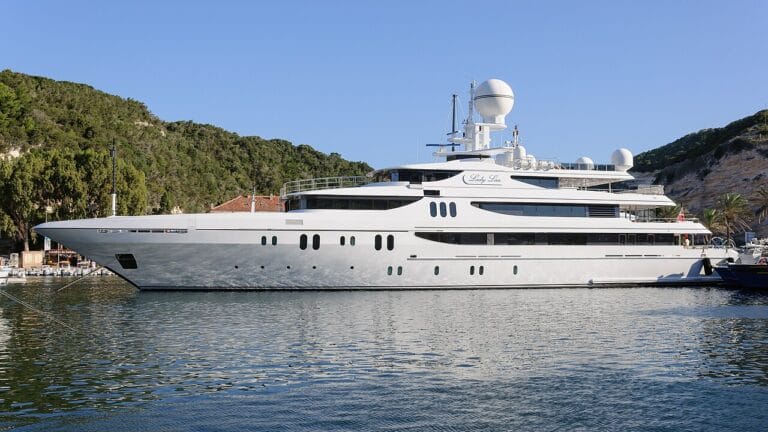
The Sanlorenzo SX112 is the most refined expression of the explorer-crossover genre — a 34-metre vessel that delivers the range of a passage maker and the interiors of a floating penthouse. It is also one of a growing number of superyachts transacted in Bitcoin, quietly and completely, by buyers who built their wealth on-chain. This is the complete guide: the brokers, the flag state calculus, the escrow structure, and the step-by-step path from letter of intent to sea trial.
Related Guides
- Buying a Riva with Bitcoin
- Chartering a Superyacht with Bitcoin: Camper & Nicholsons
- Buying a Pershing with Bitcoin
The SX112: What You Are Buying
There is a category of yacht buyer who finds the traditional motor yacht — the plumb-bow, flybridge-heavy Mediterranean cruiser — faintly provincial. They want range: the ability to cross an ocean without refueling. They want uninterrupted sightlines to the sea from every deck. The SX112 was designed precisely for this buyer, and it remains, years after its launch, the most convincing answer to the question of what a modern explorer superyacht should look like.
At 34.2 metres LOA, the Sanlorenzo SX112 sits at the upper boundary of what most owners choose to captain themselves. The hull form is semi-displacement, giving it a comfortable cruising speed of 15 knots, a top speed of 19 knots, and a transatlantic range of approximately 1,800 nautical miles at 10 knots. Sanlorenzo eliminated the visual hierarchy that places the pilothouse above the social spaces — the result is a continuous three-deck profile with unobstructed sea views from the main saloon, the owner’s suite, and the beach club, a level of interior-exterior integration the Italian yard describes as “permeability,” and that competing yards have been trying to replicate since 2018. The vessel is large enough to carry a full professional crew of six, yet compact enough to enter marinas that would turn away a 40-metre yacht. Current production lead time for a new SX112 runs approximately 18 to 24 months from contract signing to delivery.
The Broker: Why This Transaction Requires a Specialist
A superyacht purchase is not the kind of transaction you conduct directly with a shipyard. Sanlorenzo does sell new builds through its network, but the principals involved — buyer’s legal team, flag state registrar, classification society, marine surveyor, insurance underwriter — require orchestration that a general brokerage cannot provide. When you add Bitcoin to the transaction, the requirement for specialist experience becomes non-negotiable. Burgess Yachts (London, Monaco, New York) and Fraser Yachts (Monaco, Fort Lauderdale, Barcelona) are the two most consistently named by maritime lawyers who handle digital-asset transactions. Both maintain relationships with OTC desks and qualified escrow agents experienced in on-chain settlement. Denison Yachting (Fort Lauderdale, Palma) has also completed Bitcoin-denominated superyacht transactions and publishes openly about its digital asset settlement capability. Last Verified: May 2026.
When interviewing brokers for a BTC purchase, the critical questions are not about the vessel — they know the vessel. The critical questions are: Which escrow agents have you worked with on digital-asset closings? Which OTC desks do you have standing relationships with? Have you amended a MYBA contract for on-chain settlement? How do you handle settlement-day price risk? A broker who answers these questions fluently has done this before. A broker who deflects has not.
Broker commission on a new SX112 is typically 5 to 10 percent of the purchase price, split between buyer’s and seller’s broker. On a €10 million vessel, budget €500,000 to €1,000,000 in brokerage — the cost of the expertise, the network, and the legal infrastructure that makes the transaction possible.
Flag State Strategy
The flag state is the jurisdiction whose law governs the vessel. It determines regulatory obligations, crewing requirements, safety certification standards, and — critically for Bitcoin buyers — the legal framework within which the ownership structure is recognized. Choosing the wrong flag for a digitally financed acquisition creates complications that no amount of subsequent legal work fully resolves. For most Bitcoin buyers, the calculus reduces to three choices.
The Cayman Islands. The Cayman Islands Shipping Registry (CISR) operates under British maritime law, is recognized in virtually every port worldwide, and has established precedent for recognizing corporate ownership structures including those held by crypto-native holding companies. For a vessel valued at €10 million or more, a Cayman flagging through a properly constituted Cayman SPV is the most defensible ownership structure available.
The Marshall Islands. The world’s largest open registry by tonnage. Registration fees are lower, turnaround is faster, and the administration is experienced with US-connected buyers. Slightly less developed legal infrastructure for disputes than Cayman.
Malta. For buyers who intend to cruise Mediterranean waters extensively and hold EU residency, Malta offers VAT efficiency. A Maltese-flagged vessel used for charter qualifies for a reduced VAT rate of between 5.4 and 10.8 percent on the lease component. On a €10 million yacht, that is a material saving. The trade-off is greater regulatory complexity and an obligation to comply with Maltese Maritime Authority requirements.
The flag decision should be made before the purchase agreement is signed, not after. The ownership entity — whether a Cayman SPV, a Marshall Islands LLC, or a Maltese-registered company — must be the named buyer on the bill of sale, and its crypto-holding capability must be confirmed with local counsel before the deposit is transferred.
Settlement Mechanics: From On-Chain to Bill of Sale
Superyacht settlement follows a well-worn protocol built around the MYBA memorandum of agreement — the industry-standard contract that governs the overwhelming majority of large-yacht sales. A Bitcoin-denominated purchase does not replace that protocol; it amends it. The five steps below are the conventional path with the digital-asset modifications noted where they occur.
Step 1 — Letter of Intent. Non-binding. Specifies that settlement will be made in Bitcoin. Both parties’ legal counsel must review before signing.
Step 2 — Survey and Sea Trial. A qualified marine surveyor and naval architect conduct an independent survey. For an SX112, expect two to three days and €15,000 to €25,000 in surveyor fees. Sea trial follows.
Step 3 — Escrow Deposit. A 10 percent deposit placed into qualified maritime escrow. For a Bitcoin transaction, held as BTC in a multi-signature wallet or converted to USDC to eliminate volatility. The choice between the two is a genuine trade-off: BTC held in escrow preserves upside if the market rises between deposit and closing but leaves the deposit’s euro value exposed if it falls; conversion to USDC at deposit fixes the deal economics at the cost of any further appreciation. Most buyers’ counsel recommend the stablecoin route for the deposit and reserve market exposure for the balance. The MYBA standard purchase agreement is amended to reflect Bitcoin settlement terms, the agreed exchange rate mechanism, and wallet addresses.
Step 4 — Flag Registration and Bill of Sale. Your maritime lawyer arranges registration of the vessel under the chosen flag in the name of your holding entity. Classification society certificates — Lloyd’s Register, Bureau Veritas, or RINA — are transferred to the new owner.
Step 5 — Settlement Day. Settlement day is choreographed in advance to the hour: the rate-fixing window, the conversion, the wire, and the bill-of-sale release are sequenced so that no party carries unhedged exposure for longer than minutes. The balance is released from escrow. The escrow agent converts the BTC balance to EUR or USD via a qualified OTC desk and wires proceeds to the seller. Or, if the seller accepts direct on-chain settlement, BTC transfers wallet-to-wallet simultaneously with the Bill of Sale release.
Total transaction costs beyond the purchase price run 8 to 12 percent: broker commission, survey, legal fees, flag registration, and import VAT.
Annual Operating Costs
The standard maritime industry rule: annual operating costs run approximately 10 percent of vessel value. On a €10 million SX112, that is €1,000,000 per year. Breakdown: crew (€300,000–€400,000), fuel (€150,000–€250,000), marina fees (€100,000–€150,000), insurance (€80,000–€120,000), provisioning (€50,000–€100,000), maintenance (€100,000–€150,000), classification renewal (€20,000–€40,000). Charter income of €400,000 to €700,000 per season is achievable for principals willing to deploy commercially — though the editorial desk’s standing position, on yachts as on aircraft, is that charter revenue is a cost-reduction tool rather than an investment rationale. The vessel is the reward for the portfolio; it is not part of it.
The Tax Layer
Paying for a superyacht with appreciated Bitcoin triggers a taxable event in virtually every jurisdiction with a developed crypto-tax framework. The purchase is treated as a disposal: the buyer is deemed to have sold Bitcoin at fair market value on the date of settlement, with capital gains calculated on the difference between that value and the acquisition cost. For long-held coins with a low cost basis, the embedded gain on a €10 million settlement is substantial, and the liability is real.
Several structuring approaches are employed by advisers to sophisticated crypto wealth. Entity-level ownership — holding the vessel in a Cayman SPV that is itself owned by a holding structure — can defer recognition depending on the buyer’s residency. Puerto Rico Act 60 remains one of the most aggressive optimization frameworks available to US citizens. European buyers increasingly examine non-domicile regimes in Portugal, Italy, and Greece, each offering flat-tax or territorial arrangements that can materially reduce the recognized gain.
The critical point is timing: the structuring must be in place before the transaction closes. A CPA specializing in digital assets and a maritime tax attorney should be retained at the LOI stage, not after sea trial. Retroactive restructuring is expensive, legally constrained, and occasionally impossible.
The New Build Path: Ordering Direct from La Spezia
A pre-owned SX112 is the fastest path to ownership, but it is not the only path. For buyers with strong aesthetic preferences — or who intend to use the vessel as a primary residence — a new build from Sanlorenzo’s La Spezia facility offers customization the pre-owned market cannot match. The process begins with a meeting at the yard and a thorough review of the base specification, with interiors for the SX line shaped by collaborating studios including Piero Lissoni. From that point, every finish surface, mechanical system, and technical specification is the buyer’s decision.
For a Bitcoin buyer ordering new, the financial structure differs from a pre-owned transaction. Sanlorenzo’s standard payment schedule runs across the construction period in installments: typically 20 to 25 percent at contract signing, followed by progress payments tied to construction milestones, with the final installment at delivery. Each payment must be coordinated with the OTC desk and the escrow structure — the same Bitcoin-to-wire mechanism applies, but it repeats four to six times over an 18-to-24-month construction period, creating multiple settlement-day tax events that a CPA must plan for in advance.
One consideration deserves plain language: a vessel ordered today for delivery in two years is, in effect, a long-dated purchase at today’s agreed euro price, while the buyer’s Bitcoin holdings remain exposed to the market in both directions. Buyers who structure construction-period payments from current holdings are making an implicit market call with every installment. The disciplined approach is to treat each milestone payment as its own settlement event — hedged or converted on its own schedule — rather than assuming the market will cooperate across the whole construction timeline.
The Pre-Purchase Survey: What a Smart Buyer Inspects
The marine survey is the single most important step in a pre-owned superyacht purchase, and the step most frequently underweighted by first-time buyers who fall in love with the vessel before they engage the surveyor. For an SX112 — a semi-displacement hull with a complex systems package including zero-speed stabilizers, bow and stern thrusters, and an integrated automation system — a superficial survey is a dangerous survey.
The survey team should include, at minimum: a commercially qualified marine surveyor with experience on Italian-built motor yachts, a diesel mechanical engineer for the main engines and generators, and an electrical systems specialist to audit shore power, inverters, and automation. Total surveyor fees run €15,000 to €25,000 for a three-day inspection at a dry-dock facility.
The most common deficiencies discovered on pre-owned SX112s relate to gel-coat stress cracking at the swim platform (a known characteristic of the SX hull form under heavy use), galvanic corrosion on underwater gear in vessels poorly insulated from shore-power systems, and deferred maintenance on the zero-speed stabilizer actuators. None are disqualifying — all are repairable — but each is a negotiating point. A competent surveyor will value the remediation cost and adjust the proposed purchase price accordingly.
Company Crypto-Ready Profile: Sanlorenzo
| Builder | Sanlorenzo S.p.A., La Spezia, Italy |
| Model | SX112 (34.2m LOA, semi-displacement) |
| New Build Price | €9.5M–€14M depending on specification (Last Verified: May 2026) |
| Production Lead Time | 18–24 months from contract to delivery |
| Direct Crypto Acceptance | Not at yard level — transacted through broker intermediaries |
| Recommended Brokers | Burgess Yachts, Fraser Yachts, Denison Yachting |
| Recommended Flag States | Cayman Islands, Marshall Islands, Malta (EU buyers) |
| Annual Operating Costs | ~10% of vessel value (€900K–€1.1M/year) |
All pricing and broker acceptance claims verified by Bitcoinionaire editorial desk, April 2026. Acceptance policies change; confirm directly at time of transaction. Bitcoinionaire receives no compensation for broker mentions.
The Inner Circle
Private intelligence for serious crypto wealth — verified dealers, settlement guidance, and first access to new acquisition guides.