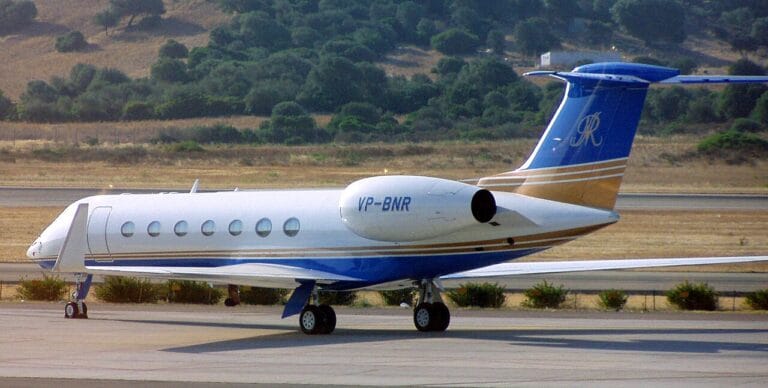

Private jet on the tarmac at dusk — Gulfstream G700 purchasable with Bitcoin

How to Buy a Gulfstream G700 with Bitcoin: The Definitive 2026 Guide

Aviation · Flagship Guide

The G700 is the most capable long-range business jet in production. It is also, increasingly, the jet of choice for principals who have made their fortunes on-chain and intend to pay for it the same way. This is the complete guide: the dealers, the settlement mechanics, the escrow structure, and the step-by-step path to taking delivery of a $78 million aircraft and paying for it in Bitcoin.

Why the G700, and Why Now

The Gulfstream G700 entered full certification in spring 2024. Within eighteen months it had displaced the G650ER as the default flagship of the ultra-long-range segment — and, quietly, as the default private aircraft of the digital-asset class. There are reasons for both.

It is, first, the most capable business jet in production. A 7,750-nautical-mile range places nearly every city pair on Earth within a single leg: New York to Dubai, London to Sydney with one stop, Los Angeles to the Maldives — direct, no-stop, with a suite at Aman’s private resort properties at either end. The cabin — at nearly fifty-seven feet of usable length, the longest in the class — accommodates five living areas, a dedicated master suite with a fixed bed, and the largest galley Gulfstream has ever built. The aircraft’s Symmetry flight deck, with its ten touchscreens and active-control sidesticks, is the most advanced cockpit in civil aviation.

But none of this is the reason the G700 has become the de-facto crypto-affluent jet. That has to do with liquidity. A G700 transaction settled in Bitcoin is, today, a sufficiently common event that the brokerage community, the escrow agencies, and the title and registry specialists are all operationally familiar with it. The rails exist. A buyer walking in with a BTC-denominated offer is not, as they were in 2017, met with confusion. They are met with a term sheet.

What a Gulfstream G700 Costs in 2026

A new G700 carries a manufacturer list price of approximately $78 million. In practice, most delivered aircraft are optioned to $82 to $84 million. Pre-owned G700s with fewer than 300 flight hours are trading in the $72 to $80 million range. As of April 2026, the global inventory of available pre-owned G700s sits in the single digits.

In Bitcoin terms, at a reference BTC/USD price of $68,000, a typical delivered G700 represents approximately 1,205 BTC. This is an institutional event, handled as such.

The Critical Distinction: OEM vs. Dealer vs. Broker

The most common misconception among first-time crypto-affluent aircraft buyers is that Gulfstream itself — the original equipment manufacturer — accepts Bitcoin. It does not. Gulfstream Aerospace, a subsidiary of General Dynamics, settles new-aircraft orders in U.S. dollars via conventional wire transfer, and there is no cryptocurrency acceptance at the factory level.

This is not an obstacle; it is a structural feature of how the transaction works. Luxury aircraft are essentially never bought directly from the OEM by an end user in the retail sense. They are bought through a broker or dealer who takes title (or acquires a delivery slot) and resells to the buyer. The crypto acceptance happens at that intermediary layer — the broker handles the conversion to wire for the handoff to Gulfstream or to the pre-owned seller.

Whole-aircraft dealers such as Aviatrade, Jetcraft, and Mente Group hold inventory and take title. Brokers such as The Jet Business and Leviate Air Group arrange transactions on commission. Fractional programs — NetJets, Flexjet, VistaJet — sometimes accept crypto on membership deposits.

Verified Dealers — G700-Class Bitcoin Transactions

The following dealers and brokers have documented capacity to execute a G700 or G700-class transaction settled in cryptocurrency above the $50 million threshold. Last Verified: May 2026.

Aviatrade

Aviatrade, of Morristown, New Jersey, is the dealer most frequently associated with crypto-settled whole-aircraft transactions in the North American market. The firm publicly confirmed its first Bitcoin-settled aircraft sale in 2018 and has since completed such transactions across the Gulfstream, Bombardier, and Embraer product lines. For a G700 acquisition, Aviatrade will typically structure the deal through an escrow partner that handles the BTC-to-USD conversion at a pre-agreed price on closing day. Settlement currencies supported: BTC, ETH, USDC, USDT.

Jetcraft

Jetcraft is the world’s largest aircraft dealer by transaction volume, with a portfolio spanning the Gulfstream, Bombardier, Dassault, and Embraer lines. The firm has not marketed crypto acceptance as an institutional offering, but it has executed BTC-settled transactions on request for qualifying buyers, typically through a third-party escrow. The editorial desk recommends an initial conversation framed around delivery timing and aircraft availability first, with settlement currency raised at the letter-of-intent stage. Settlement currencies supported: BTC, USDC, by arrangement.

The Jet Business

London-based The Jet Business, led by Steve Varsano, is the foremost European brokerage for ultra-long-range aircraft. The firm has handled cryptocurrency-settled transactions for European and Gulf-based principals, frequently using Swiss and Liechtenstein-based escrow structures to accommodate both the regulatory environment and the buyer’s preferred custody arrangement. For a G700 transaction originating outside the United States, this is the reference brokerage. Settlement currencies supported: BTC, ETH, USDC, by arrangement.

Leviate Air Group

Leviate Air Group, headquartered in Dallas, has positioned itself deliberately in the ultra-high-net-worth segment and has executed Bitcoin-settled transactions in the Global 7500 and Falcon 8X categories. The firm is a practical option for buyers who value a single point of contact across acquisition, management, and eventual disposition. Settlement currencies supported: BTC, by arrangement.

Mente Group

Dallas-based Mente Group offers a full-service acquisition consultancy that has completed crypto-settled transactions primarily for technology-sector and digital-asset-native principals. The firm’s value is most pronounced on the pre-owned side, where Mente’s technical inspection protocols are among the most rigorous in the industry — relevant for a G700 given the youth of the secondary market. Settlement currencies supported: BTC, ETH, by arrangement.

Settlement Mechanics

Approach 1: Escrowed Conversion on Closing

The most common structure. The buyer transfers BTC to a qualified aviation escrow agent — IATS, Aero-Space Reports, and McAfee & Taft all maintain digital-asset capability — where it is held pending closing conditions. On closing day, an institutional OTC desk such as Cumberland or Galaxy Digital executes the conversion at a rate fixed within a pre-agreed window, and the resulting wire is released to the seller simultaneously with title transfer. The buyer holds Bitcoin until the last practicable moment; the seller receives dollars; neither side carries overnight settlement risk.

Approach 2: Pre-Closing Liquidation

The buyer liquidates BTC two to four weeks before closing and funds the transaction by conventional wire. This is the simplest structure from the dealer’s perspective — the aviation side of the deal proceeds exactly as a fiat purchase — and it decouples the tax event from the purchase itself, which some advisers prefer for clean year-end accounting. The cost is exposure: the buyer is out of the market between liquidation and closing.

Approach 3: Direct On-Chain Settlement

BTC transfers directly from the buyer’s wallet to the seller’s, simultaneous with the bill of sale. This is the least common structure because it requires the seller to maintain institutional custody infrastructure and to accept mark-to-market exposure on a nine-figure position. It appears almost exclusively when the seller is also a digital-asset principal — in which case it is the fastest and cheapest settlement path in aviation.

The Transaction, Step by Step

1. Pre-Qualification and Representation (Week 1)

Engage a buyer’s broker and private-aviation tax counsel. The broker’s fee structure should be transparent — typically 1 to 2.5 percent of transaction value — and their incentive aligned with the buyer rather than the seller. The editorial desk considers independent buyer representation non-negotiable on any G700 transaction, crypto-settled or not.

2. Aircraft Sourcing and LOI (Weeks 2–4)

The broker surveys available inventory and presents a shortlist. The buyer issues a Letter of Intent, which reserves the inspection period and establishes the settlement-currency framework: the proposed conversion methodology, the escrow agent, and the crypto-to-fiat rate-fixing mechanism are all specified here.

3. Pre-Buy Inspection (Weeks 4–8)

The buyer’s technical representative conducts a full pre-buy inspection at a qualified MRO facility — typically Gulfstream’s own Savannah or Brunswick service centers for a G700, though Duncan Aviation and Jet Aviation are also industry-standard. The inspection covers airframe, systems, logbook integrity, airworthiness directives, and interior condition. Expect a findings report; expect to negotiate.

4. Purchase Agreement (Weeks 8–10)

The binding Aircraft Purchase Agreement is executed with the crypto-settlement mechanics fully specified: the originating wallet, the escrow wallet, the OTC counterparty, the rate-fixing window, and the fallback provisions in the event of a settlement-day price dislocation exceeding a pre-agreed band, typically ±5 percent.

5. Closing and Delivery (Weeks 10–12)

On closing day, Bitcoin is transferred to the escrow wallet. The OTC desk executes the conversion. The resulting USD wire is released to the seller. The FAA registration is re-issued, title and keys transfer, and delivery is accepted — typically at the seller’s designated facility or a neutral handover point.

Tax Considerations

Spending appreciated Bitcoin on a G700 is, in nearly every jurisdiction, a taxable disposition — economically equivalent to selling the Bitcoin and using the proceeds to buy the aircraft. For a buyer whose BTC position carries a cost basis near zero, the capital gains exposure on a $78 million transaction is substantial enough that tax planning typically dictates the timing and structure of the deal more than any other single factor.

Several strategies are worth understanding before a Letter of Intent is signed. Charitable-remainder structures can absorb meaningful portions of the gain for buyers with established philanthropic vehicles. Installment-sale characterization can defer recognition across tax years if the transaction is structured with a legitimate payment schedule. Residency planning — Puerto Rico’s Act 60 remains the highest-profile example — can materially change the effective rate for buyers willing to establish bona fide residence.

None of these are do-it-yourself maneuvers. Engage a private-aviation tax adviser (Crowe LLP and Holland & Knight both maintain credible aviation practices) and a digital-asset CPA before the LOI. The combined fee is a small fraction of one percent of the transaction; the savings, commonly, are multiples. For buyers structuring the acquisition through a family office or offshore holding vehicle, a crypto-friendly private bank with structured product capabilities can manage the hedging and settlement in a single workflow.

Annual Operating Costs

A G700 is not a passive asset. Crew, maintenance, hangar, insurance, and fuel run $3.5 to $5 million annually for a typical owner-flown profile of 350 to 500 hours. Some owners place the aircraft on a charter management program to partially offset these costs, though the economics of chartering out a $78 million asset are marginal at best — the editorial desk’s position is that charter revenue should be treated as a cost-reduction tool, never an investment rationale.

Most G700s are held in a special-purpose LLC owned by a family office, which provides liability segregation, privacy, and flexibility on eventual disposition. For a crypto-native principal, the SPV structure also accommodates clean, auditable accounting of the original acquisition. Buyers assembling a full trophy-asset portfolio alongside the aircraft — including private island ownership — typically structure the LLC to hold all assets under a single controlled entity, reducing management overhead and consolidating insurance arrangements.

All pricing and dealer acceptance claims verified by Bitcoinionaire editorial desk, April 2026. Acceptance policies change; confirm directly with dealer at time of transaction. Bitcoinionaire receives no compensation for dealer mentions.

The Inner Circle

Private intelligence for serious crypto wealth — verified dealers, settlement guidance, and first access to new acquisition guides.

Request Membership