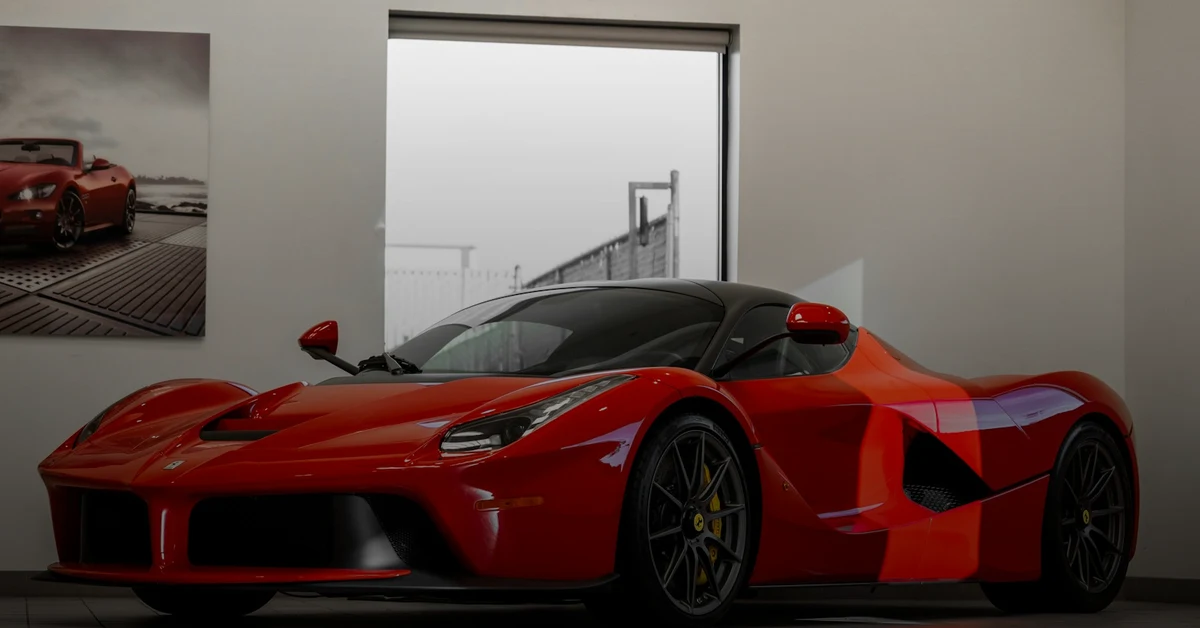

Ferrari is the only automaker in the world where Bitcoin has been a legitimate, authorized payment method at the factory level since 2023. While competitors accept cryptocurrency only through specialist brokers or gray-market intermediaries, Ferrari integrated BitPay directly into its North American dealer network in October 2023, then extended the program to European dealers by July 2024, and to its broader international network by the end of that year. Walk into a participating authorized Ferrari dealership today and you can settle a new 296 GTB, a Roma, or an SF90 Stradale as directly as you would at a crypto exchange, with no wire transfers, no conversion paperwork, and no added markup.
Ferrari is not a brand that chases trends. The decision to accept Bitcoin, Ether, and USDC was deliberate, driven by documented demand from a new cohort of ultra-wealthy buyers, the same cohort for whom this guide exists. What follows is the complete field guide: the models worth considering, how Ferrari’s official BitPay program works, the secondary market for buyers seeking pre-owned or allocation-free inventory, OTC mechanics for large transactions, and the settlement, registration, and tax considerations specific to crypto-funded purchases.
Last Verified: June 2026
Availability note (updated 21 July 2026): BitCars (bitcars.eu) has been unreachable since 20 July 2026, returning a Cloudflare origin error (521) on every check, and its sister storefront BitDials (bitdials.eu) — the same operator, BD Project — has returned the equivalent error (522) throughout the same period. We have no evidence the business has ceased trading, but a storefront that cannot be reached cannot be transacted with, and Bitcoinionaire has withdrawn BitCars as a recommended route until the site returns and its acceptance is re-verified. Do not send funds to any party claiming to transact on BitCars’s behalf while its storefront is down. The other settlement paths profiled in this guide are unaffected.
Route withdrawn — update, 26 July 2026. Seven consecutive days of checks now show both bitdials.eu and bitcars.eu (the same operator, BD Project) returning Cloudflare origin errors — 522 and 521 respectively — with no response at any point since 20 July 2026. The BitDials/BitCars dealer profile and the verified-partner table entry that previously appeared in this guide have therefore been removed. Any remaining reference to BitDials or BitCars below describes the route as it stood in May 2026 and is superseded by this notice: treat it as Unverified — confirm directly. For a settlement path verified this month, see The 1916 Company, which accepts Bitcoin, Ethereum and leading stablecoins via BitPay. Last Verified: July 2026.
Why Ferrari Is the Car for Crypto Buyers
Most luxury goods operate on a straightforward scarcity model: the price is high, supply is modest, and the brand maintains exclusivity through pricing alone. Ferrari operates differently. Production is capped by decree — not by market forces, but by an internal philosophy that demand must always exceed supply. In 2023, Ferrari delivered approximately 13,663 vehicles globally. That number has not grown meaningfully in years, and Ferrari has publicly stated it will not allow volume to chase demand.
The consequence is a car that behaves less like a consumer product and more like a financial instrument. Virtually every Ferrari model holds or appreciates in value over a three-to-five-year holding period. The SF90 Stradale, priced at roughly $510,000 at invoice, has traded above $700,000 on the secondary market. Limited editions routinely triple in value within twelve months. For a buyer whose wealth is denominated in Bitcoin, a Ferrari represents a conversion from one appreciating, supply-constrained asset into another — with the additional benefit of being drivable.
Ferrari also carries institutional legitimacy that no other car brand can match at this price point. The Prancing Horse is among the most recognized luxury symbols on earth. For buyers building a portfolio of hard assets alongside crypto holdings, Ferrari sits in the same conversation as Patek Philippe, Van Cleef & Arpels, and Hermès — trophy assets that announce wealth without explanation.
Ferrari’s Official Crypto Payment Program
Ferrari’s partnership with BitPay is the cleanest path to a Bitcoin-funded Ferrari purchase available anywhere. The mechanics are straightforward. When a buyer agrees to purchase terms with a participating authorized dealer, the dealer generates a BitPay payment request. The buyer scans a QR code with their wallet — Bitcoin, Ether, or USDC are all accepted — and the transaction settles instantly. BitPay converts the crypto to fiat at the prevailing rate, locks that rate for the duration of the transaction, and delivers the local currency equivalent to the dealership. The buyer receives no different treatment than a cash buyer. The dealer sees no crypto exposure.
Ferrari does not impose any surcharge or markup for crypto payment. The price you negotiate in dollars is the price you pay in Bitcoin equivalent — the only variable is the exchange rate at the moment of settlement, which BitPay locks in to protect both parties from volatility during processing.
BitPay also performs AML (Anti-Money Laundering) screening on all transactions. The system verifies that the sending wallet is not flagged by OFAC or other compliance databases before processing — meaning Ferrari’s crypto acceptance is fully compliant and defensible to any regulatory inquiry. This is not a loophole. It is a formalized payment rail.
One practical note: not every Ferrari dealer in a participating market has activated the BitPay system. Call ahead, confirm the dealer is enrolled, and — if purchasing a new allocation — request that the deposit be settled via BitPay as well. Most dealers will accommodate this without friction.
The Ferrari Lineup: Three Models Worth the Consideration
Ferrari’s current lineup spans eleven models at varying price points and performance levels. Three stand out as the most relevant for crypto buyers in 2026 — each occupying a different position in the value and collectibility spectrum.
Ferrari SF90 Stradale — The Flagship Hybrid Supercar
The SF90 Stradale is the most technically ambitious road car Ferrari has ever produced, and it is the closest the company has come to a publicly available hypercar. A twin-turbocharged 4.0-litre V8 producing 769 horsepower works alongside three electric motors — one on the rear axle, two on the front — for a combined system output of 986 horsepower and 590 lb-ft of torque. The result is a 0–60 time of 2.5 seconds and a top speed of 211 mph, from a car with rear seats, air conditioning, and daily usability.
New pricing starts at approximately $507,000 and rises steeply with options — a fully configured car with Assetto Fiorano package, carbon fibre racing seats, and bespoke exterior paint will exceed $650,000. Market prices on the secondary market for low-mileage examples have consistently cleared $700,000.
The SF90 Stradale is Ferrari’s clearest statement of technological intent. It is also the brand’s most likely candidate for collectibility — a car that signals the transition between internal combustion supremacy and the hybrid era. Buyers purchasing with Bitcoin today are acquiring a marker of a specific moment in Ferrari’s history, which has historically been a reliable formula for appreciation.
Ferrari 296 GTB — The Purist’s Hybrid
Where the SF90 Stradale prioritises raw performance and technology density, the 296 GTB is built around driving engagement. Its architecture — a mid-mounted 3.0-litre twin-turbocharged V6 mated to a single rear-axle electric motor — is Ferrari’s most emotionally compelling powertrain in a generation. Combined output stands at 830 horsepower, but the character of that power delivery, the V6’s high-revving acoustics, and the car’s lighter weight relative to the SF90 make the 296 GTB a favourite among Ferrari insiders.
Base pricing starts at approximately $342,000, making it the most accessible point of entry into Ferrari’s hybrid lineup. It is also the model most likely to be in-stock at dealers without a multi-year allocation wait — though buyer demand in certain markets still outstrips supply for the most desirable configurations.
The 296 GTB is the right choice for the buyer who wants a Ferrari they will actually drive — a car that rewards the physical act of piloting it, rather than existing primarily as a stored asset. For crypto buyers deploying wealth into enjoyment as much as investment, the 296 GTB makes a compelling case.
Ferrari Roma — The Grand Tourer
The Roma represents Ferrari’s most deliberate pivot toward elegance over aggression. Named for the city rather than a racing designation, it carries bodywork by Ferrari’s Centro Stile that has drawn comparisons to the 250 GT Lusso — a car widely considered one of the most beautiful Ferraris ever made. Its 3.9-litre twin-turbocharged V8 produces 612 horsepower, enough for a 0–60 time of 3.4 seconds, but the Roma is not optimised for track days. It is built for long-distance high-speed cruising.
Pricing begins at approximately $274,965, placing it as the most accessible Ferrari in the current lineup. That accessibility should not be read as a compromise — the Roma’s proportions, interior quality, and driving character are fully in keeping with Ferrari’s standards. For buyers seeking a daily-driver Ferrari or a first entry into the marque, the Roma is the natural starting point.
The Roma is also offered as a Spider at a modest premium, and Ferrari’s Tailor Made programme permits nearly unlimited bespoke specification on any commission — a consideration for buyers whose Bitcoin wealth extends to commissioning a car that will be singular.
The Secondary Market Route: iLusso and Specialist Brokers
For buyers who cannot or prefer not to navigate an authorized dealer allocation process, the secondary market offers an established and well-documented alternative. Three platforms have emerged as the most reliable channels for crypto-funded Ferrari acquisitions outside the factory network.
BitCars.eu (Unverified — storefront unreachable since 20 July 2026) is a European-based marketplace that accepted cryptocurrency for exotic car purchases from its founding and maintained an active Ferrari inventory — typically including models such as the 812 GTS, California T, and various pre-owned SF90 and 296 GTB examples. Transactions on BitCars were denominated in Bitcoin and settled peer-to-peer through an escrow mechanism, with the vehicle transferred upon confirmed settlement, under full AML compliance and KYC documentation for all buyers. That description reflects the route as it stood in June 2026 and cannot be confirmed while the storefront is down. Last Verified: June 2026.
iLusso operates as a Southern California-based exotic car specialist and describes itself as one of the largest buyers of exotic vehicles in the United States. It accepts cryptocurrency payments via BitPay across its inventory, which regularly includes Ferrari models at multiple price points. iLusso’s advantage for US-based buyers is the ability to inspect vehicles in person before transacting — a meaningful assurance when committing six-figure sums in Bitcoin. Last Verified: June 2026.
Crypto Emporium maintains a global inventory of luxury goods including Ferrari vehicles and accepts Bitcoin, Ethereum, and a range of altcoins. The platform’s strength is breadth — buyers can source vehicles from across the world and transact in whichever cryptocurrency best suits their portfolio. Crypto Emporium also handles all import, shipping, and customs logistics for international transactions, which simplifies cross-border purchases considerably.
When transacting through any secondary market platform, buyers should commission an independent pre-purchase inspection (PPI) by a Ferrari-certified technician before settlement. The inspection cost — typically $500–$1,500 — is negligible relative to the transaction value and provides confirmation that service history, accident history, and mechanical condition are as represented. Request the full service history, confirm the car has never had a major structural repair, and verify the VIN against official Ferrari records.
The OTC Path for Ultra-High-Net-Worth Buyers
Buyers whose Bitcoin holdings are large enough to trigger exchange liquidity concerns — typically positions above $500,000 that cannot be liquidated at market rate without price impact — should consider the OTC (over-the-counter) route. Rather than selling Bitcoin on an exchange and wiring fiat to a dealer, an OTC desk negotiates a block trade price for the Bitcoin and settles directly with the dealer in fiat, or arranges for direct Bitcoin-to-vehicle settlement through a broker.
The practical mechanics vary by counterparty. At minimum, the buyer engages a regulated OTC desk — Coinbase Institutional, Galaxy Digital, or a private bank with a crypto trading desk — provides KYC documentation, agrees on a settlement rate, and coordinates timing with the dealership. Some OTC desks have existing relationships with luxury car brokers and can manage the entire transaction from Bitcoin wallet to vehicle title transfer as a single workflow.
OTC settlement is particularly relevant for buyers purchasing multiple Ferraris simultaneously, or for those commissioning a Tailor Made specification on a new car — where the transaction may span several months between deposit and delivery. For these structures, the buyer and dealer typically agree to Bitcoin pricing benchmarked to a specific future date, with a fiat equivalent guarantee that protects the dealer from downside volatility. A crypto-friendly private bank with structured product capabilities can construct this hedge formally.
Settlement Mechanics: Step by Step
Whether purchasing through an authorized dealer or a secondary market platform, the transactional sequence follows a consistent pattern once the crypto payment rail has been established.
First, negotiate and agree on the vehicle price in the local fiat currency. All pricing discussions should occur in dollars or euros — never in Bitcoin — to eliminate the ambiguity of rate fluctuation during negotiation. Once price is agreed, confirm the dealer or platform’s accepted cryptocurrencies and the processor they use (BitPay, direct wallet, or escrow).
Second, complete the dealer’s KYC and documentation requirements before initiating any crypto transfer. For an authorized Ferrari dealer, this typically mirrors a standard vehicle purchase: proof of identity, proof of insurance (for a new vehicle), and financing or payment confirmation. The crypto source of funds will not trigger unusual documentation requirements beyond what standard AML compliance demands.
Third, initiate the crypto transfer only when the dealer or platform has generated the payment request and confirmed the rate lock. Do not send crypto to a wallet address provided via email without independently verifying it through the platform’s official interface — invoice fraud is rare in established channels but has occurred in peer-to-peer transactions.
Fourth, confirm settlement. BitPay and most established processors confirm transactions within one to three on-chain confirmations — typically under thirty minutes for Bitcoin, faster for Ethereum. Once confirmed, the dealer proceeds with the standard title and delivery process as for any cash sale.
Registration, Title, and Ongoing Costs
Ferrari ownership carries costs beyond the purchase price that any Bitcoin buyer should factor into their calculus. Servicing a Ferrari on the factory schedule is non-negotiable if warranty coverage is to be maintained — annual service at an authorized dealer typically runs $2,000–$5,000 depending on mileage and model, with major services (cam belt, clutch) approaching $15,000 on some models. Insurance for a $500,000 SF90 Stradale from a specialist insurer such as Hagerty or Chubb runs approximately $8,000–$15,000 annually, varying by driver profile and storage conditions.
Registration in the United States follows the same process as any vehicle purchase — the dealer typically handles title transfer and temporary registration at time of sale. Sales tax is assessed on the purchase price in the buyer’s state of residence, calculated on the fiat equivalent of the Bitcoin paid. There is no special tax treatment for crypto-funded vehicle purchases; the transaction is treated identically to a cash purchase from the state’s perspective.
For buyers in no-income-tax states such as Florida, Texas, or Nevada, purchasing and registering a Ferrari carries materially lower ongoing tax obligations than the same car registered in California. This consideration, while not unique to crypto buyers, is worth weighing when deciding where to take delivery.
Tax Considerations for Bitcoin-to-Ferrari Transactions
In the United States, spending Bitcoin to purchase a vehicle is a taxable disposal event. The IRS treats Bitcoin as property, meaning any gain between your acquisition cost (cost basis) and the value of Bitcoin at the time of disposal is subject to capital gains tax. If you purchased Bitcoin at $30,000 per coin and used it to buy a Ferrari when Bitcoin traded at $100,000 per coin, the $70,000 gain per coin is taxable — long-term capital gains rates apply if the Bitcoin was held more than twelve months.
This consideration does not change the net cost of the Ferrari for buyers sitting on long-term holdings, but it does affect planning. Buyers with significant unrealized gains may prefer to time the transaction during a tax year where they have offsetting losses, or to work with a crypto-specialist CPA to structure the disposal in the most tax-efficient way. Some buyers use the OTC route to manage the timing of the taxable event relative to their broader portfolio position.
Bitcoin held in a self-directed IRA (through custodians such as Bitcoin IRA or iTrustCapital) cannot be used to directly purchase a vehicle without distribution, which would trigger income tax. For buyers in this position, liquidating through the IRA first — and paying the distribution tax — may still be preferable to selling from a taxable account with a high cost basis, depending on the specific numbers. Consult a tax professional before transacting.
Ferrari Tailor Made: The Bespoke Commission Path
For buyers whose ambition extends beyond choosing from the options catalogue, Ferrari’s Tailor Made programme represents the pinnacle of automotive personalisation. Through Tailor Made, Ferrari’s Centro Stile team works directly with the buyer to specify a unique combination of exterior colour, interior materials, stitching, carbon fibre trim, and — on select models — structural modifications not available in the standard options list.
Tailor Made commissions add 20–50% to the base price of the car, depending on the scope of customisation, and carry lead times of twelve to twenty-four months. Bitcoin buyers commissioning a Tailor Made car through an authorized dealer can structure the deposit and progress payments via BitPay, though the extended timeline means coordinating multiple crypto settlements across the production period. It is advisable to lock in fiat equivalents at each payment milestone rather than denominating the full commission in Bitcoin and settling at delivery — twelve months of price movement in either direction introduces unnecessary risk to both buyer and dealer.
A Tailor Made Ferrari is, by definition, the only one of its specification in existence. These cars command a premium on the secondary market that can exceed the Tailor Made uplift itself — the right combination of exterior colour and interior specification, executed with Ferrari’s involvement, has historically been among the most reliable value stores in the collectible car market.
Frequently Asked Questions
Yes. Ferrari launched a crypto payment program via BitPay at its North American authorized dealerships in October 2023, later extending it to European and global dealers through 2024. Accepted currencies are Bitcoin (BTC), Ether (ETH), and USDC. There are no additional fees or markups for crypto payments. Confirm directly with your preferred dealer that they have activated the BitPay system before visiting. Last Verified: June 2026.
The SF90 Stradale has demonstrated the strongest secondary market appreciation of any current-production Ferrari — examples purchased at invoice have traded at significant premiums. However, “best investment” depends on hold period, risk appetite, and whether you intend to drive the car. The 296 GTB is the better choice for buyers who will put miles on the car. The Roma is the right entry point for first-time Ferrari owners. All three are supply-constrained assets with strong historical value retention.
In the United States, using Bitcoin to purchase any asset — including a vehicle — is a taxable disposal event. You owe capital gains tax on the difference between your Bitcoin cost basis and its value at the time of purchase. Long-term capital gains rates apply if the Bitcoin was held more than twelve months. Sales tax on the vehicle itself is assessed on the fiat equivalent of the crypto paid, identical to a cash purchase. Consult a tax professional before transacting.
The Ferrari Roma starts at approximately $274,965 at authorized dealers in the United States and represents the most accessible point of entry into the current Ferrari lineup. Pre-owned models at secondary market platforms such as iLusso can be sourced at lower price points depending on model year and mileage; BitCars.eu has been unreachable since 20 July 2026 and is Unverified. Last Verified: June 2026.
BitPay locks the exchange rate at the moment the payment request is generated and accepted by the buyer. The rate is fixed for a short window — typically fifteen minutes — during which the buyer must complete the crypto transfer. Once the transaction is confirmed on-chain, BitPay settles the fiat equivalent with the dealer. The buyer is exposed to Bitcoin’s market price only in the time between agreeing to purchase terms and initiating the BitPay payment request — which is typically minutes, not days.
Yes. Crypto Emporium handles international transactions including shipping and customs. BitCars.eu, the European crypto car marketplace long cited for Ferrari inventory, has been unreachable since 20 July 2026 and is Unverified — confirm directly. Ferrari’s official BitPay program was also extended to European authorized dealers from July 2024. Regulatory requirements vary by country — buyers should confirm the legal status of crypto-funded vehicle purchases in their jurisdiction. Last Verified: June 2026.
The Acquisition Desk
Considering an acquisition? The Desk connects qualified readers with the verified brokerages and dealers named in our guides — discreetly, and without obligation.
Further Reading
- Buying an Aston Martin with Bitcoin: Dealer, BitPay, and Settlement
- Buying a Bentley with Bitcoin: Dealer, BitPay, and Settlement
- Buying a Lamborghini with Bitcoin: The Definitive Guide
- Buying a Porsche with Bitcoin: The Definitive Guide
- Buying a Bugatti with Bitcoin: The Definitive Guide
- Luxury Cars You Can Buy with Bitcoin: The Complete Guide
- Crypto-Friendly Private Banking: Managing Wealth at Scale
- Ferrari, Lamborghini, and Rolls-Royce: The Crypto Car Buyer’s Guide
- Staying at the Burj Al Arab with Bitcoin: The Definitive Guide
- Luxury Car Rental with Bitcoin: Drive It Before You Buy It